|
Number patterns and potential uses.
Evens and Odds
These are the two primary structures in all of numerics, the
evens and odds, 0's and 1's, negatives and positives. Each has a special sequence of numbers within them. Prime
numbers for the odd sequence, which are only divisible by themselves, and the perfect even sequence used in binary, which
are only divisible amongst themselves. All other numbers are hybrids of evens and odds. This notion becomes visible when
you square individual numbers. The numbers being used always control the patterning and sub-fractals of the prime factors
involved can be easily incorporated to squares.
Interesting to acknowledge is the fact that there are three
different potentials when adding evens and odds. Two evens equal an even number, two odds equal and even number,
but one even and one odd equal an odd number. 2 to 1 odds or two thirds in favor of even.
The Fibonacci Sequence
There is still some debate as to how the beginning of the sequence should
occur, but in my translation and understanding, 0 is a number and should be accounted for. As it stands, many scholars contest
that the sequence should start with 1 and then be followed by a second 1 and then the 2, etc. The reasoning being
that the sequence relies on the addition of successive pairs of numbers. 1+1 = 2, 2+3 = 5, 3+5 = 8, etc. This thinking
also defies the numbering. 1 only occurs once in the natural order of numbers, not twice. Also, 0 and 1 = 2 digits, so it
is arguable to say that 0+1 = 2. 0 figures in to different patterns in math, primarily binary, but also into magic squares.
I have found other sequences as well that give relevance to the number 0.
An interesting pattern to be found within the Fibonacci sequence
itself, which proves the existence and need for a number in the position before 1, is the fact that if you were to count out
the positions sequentially, the successive numbers will be divisible by the original number in the sub-sequence. For
example the number 5 happens to be the fifth number in the sequence. 0, 1, 2, 3, 5. If you count out every fifth number in
the Fibonacci sequence, it will be divisible by 5. If you pick the 8, which is in the sixth position, every sixth number is
divisible by 8. 13 becomes the seventh number, and every seventh number from 13 is divisible by 13, and so on. This doesn't
prove that 0 is the first number, but it does prove that the 0, 1, 1, 2,... theory is wrong and that there is only one
digit before the 1. This I have to leave to the discretion of the reader, but it is the concept that I will continue to follow
until proven otherwise.
Phi
In the Fibonacci sequence, the lower number in each pair divides
into the higher number to create a consistant number near equal to 1.618 on the average. Our modern understanding of phi has
been translated into the equation, 1 plus the square root of 5 divided by 2 to equal 1.618... The sequencing occurs in
numerous circumstances in physical life and is highly documented. The most essential structuring is in the manifestation of
energy itself along these lines. The logarithmic spiral that is phi can be located in whirlpools, tornadoes, hurricanes, and
even galaxies, as well as land formations. It is speculated that electricity is also a very tightly compacted vortice, always
manifesting at its tightest point. In a lightning strike or tornado, this would be from the ground up.
Binary
I've written a lot about this sequence already with
disregard to those who may not know or understand how binary works. I marvelled for years at how the entire number system
could be broken down into a simple series of 0's and 1's, and always thought I had to be a mathematical genius to understand
it. When, in reality, it is quite simple.
In an 8-bit, system you are given 8 positions. Traditionally,
binary is written from right to left. So, picture 8 boxes, each with a preassigned number. The numbers used are 0/1, 2, 4,
8, 16, 32, 64, 128, and just keep doubling the numbers as needed. (0 and 1 occupy the same place.). In an 8-bit
scenario, you can find any number in between by simply adding the highest numbers in the sequence without going over your
target number. Once you find the numbers you need to use to add to your number, you simply put a 1 in those positions and
fill the rest of the unused spaces with 0's. For example, 72: 64 is the closest number in the sequence without going over,
so this would be the first space to place a 1. After that, all you need is an 8, so you place a 1 in that position. Now fill
in the rest of the spaces in between with 0's and you have your answer. 72 in binary = 1001000.
The numbers used in the sequence are actually perfect evens.
These numbers are the only even numbers that cannot be divided by an odd number higher than 1. Also, they can only be divided
by the numbers before them in the sequence.
The knowledge of this pattern spans the globe in ancient
times, from India to Egypt to China, and was actually translated from I-Ching by Gottfried Leibnitz in the early 1700's
to give us our modern binary system.
Anonymous Centering Sequence
There is still another sequence unaccounted for that needs attention.
It works off the number 7 and produces an interesting and relevant number sequence similar to the ones described above. It
goes as follows: 1, 4, 7, 13, 25, 49, 97, 193, 385, 769, etc. Each number is actually the center number of the next number
in the pattern. All odd numbers have a center number as I will call them. For example: the center number for 5 is 3. You'll
have two numbers before and after the 3. The center of 7 is 4, three numbers before and after 4. The center of 9 is 5,
with four numbers before and after 5, etc.
The more important numbers here are 193 and 385. If you were
to add all of the numbers 1 through 193, the sum is 18721. In the I-Ching, 192 positives and 192 negatives are incorporated
for a grand total of 384 total negatives and positives in the entire structure. 18720 is a fractal of the Mayan numbering
system and is divisible by 64 different numbers and 64x3 = 192.
The 7's and 13's figure strongly in the Mayan Tzolkin as well,
and I think most people understand the relevance of the number 25 because of its consistant use globally in the decimal system.
49 as the square of 7 falls into place and strengthens the 7
and its importance. Remember also that 0 through 7 is counted out as the only possible combinations in the 3-bit structure
in Octal math and the I-Ching, and I find consistent praise in the ancient world for the number 7.
If you were to start the sequence on 0 it would read as follows:
0, 3, 6, 12, 24, 48, 96, 192, 384, 768, etc. Here, it is mimicing the doubling sequence in binary and the 0 has to be acknowledged
as a position in the sequence, just with no value. The amount of numbers stays the same.
When setting the I-Ching to its binary magic square format,
each row will contain 48 negatives and positives (24 of each). If used in the DNA definitions, you would have 96 base pairings
per line in the magic square. Which ultimately means 3 base pairs per trigram, 6 per hexagram, 12 per number pairing, 24 negative
and positive pairings for 48 total per line, making 96 bases per line, at 192 negative and positive pairs per 64 hexagram
structure, for a grand total of 384 negative and positive base pairings. 384x2 = 768, which would be the total amount of bases
per 8x8 format.
Octaves
Any musician and music lover alike can appreciate the octave
scale. It also makes for easy math when dividing whole numbers by 8. The .125, .25, .375, .5, .625, .75, .875 occur consistently
when dividing numbers by 8. Consequently, 5 squared equals 125. A fractal of this number is 12.5, which is the center
of the 13. Another fractal being .125, which is one eighth of one. And so, you have the numbers 5, 8, and 13 interworking
amongst themselves to create the octave system.
In music, 13 tones are incorporated with the octave scaling
to produce the music you hear.
Technically, 1.625 is phi, and this portion of the Fibonacci
system figures prominantly into the Mayan number system.
- .125x13 = 1.625, or 13 eighths.
- .125x20 = 2.5
- 1.625:2.5 = 13:20
Many physicists today will tell you that the entire universe
is actually an ongoing song and all of physical reality is created by vibrations that can be translated into musical tones
or notes, as well as colors, which are known to be created by certain levels of vibration.
The Turtle Shell
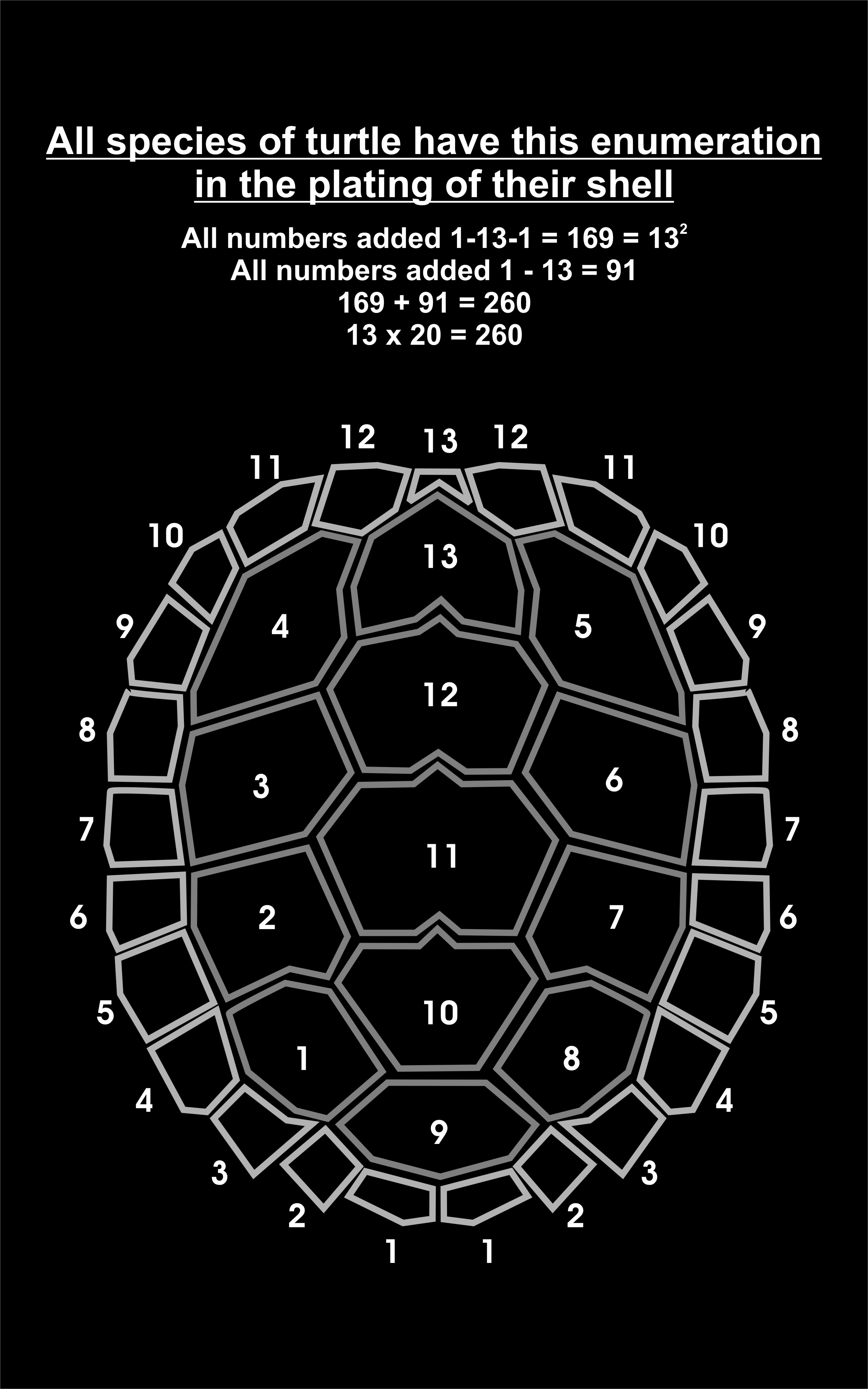
| The Maya revere a place called Turtle Island |
|
|
| * Ancient divination was often etched on turtle shells. |
|